
Batch Baking: How to Bake 24+ Cupcakes at Once
By Sarah, Incr-EdibleCupCakes. Updated 2026-08-13.
To bake 24 or more cupcakes at once, use two half sheet trays on separate racks, rotate them halfway through baking, and bake in batches of 12 to 24 rather than cramming every tray in at the same time.
| Oven Type | Max Trays at Once | Rotation Needed |
|---|---|---|
| Standard oven, no convection | 2 trays | Yes, once at halfway point |
| Convection oven | 3 trays | Yes, once, shorter pause needed |
| Double oven setup | 4 trays total | Rotate each oven separately |
Why Batch Baking Cupcakes Is Different From Baking a Single Tray
Batch baking is different because more trays in the oven change how heat moves around, not just how many cupcakes you get. One tray on a center rack bakes evenly because hot air circulates freely on all sides.
Add a second or third tray and you block airflow, create hot pockets near the back wall, and cool the oven faster every time you open the door. I learned this the hard way when my first 36 cupcake order came out with pale tops and dense middles on one tray, and dark crispy edges on another.
How Many Cupcake Trays Can You Actually Bake at Once
Most home ovens handle two trays well, and struggle with three or more without real adjustments. A standard 30 inch oven has room for two racks with 2 inches of clearance around each tray, which is the minimum space air needs to circulate.
If you own a convection oven, three trays can work because the fan forces air movement even in tight spots. Without convection, a third tray usually means the middle rack tray gets shortchanged on heat from both directions.
- Standard oven, no convection: bake 2 trays max, 12 to 24 cupcakes.
- Convection oven: 3 trays possible with 5 to 10 minutes added rotation time.
- Double oven or oven plus toaster oven: run both for true 24 to 48 batch.
Rack Placement for Even Heat Distribution
Even heat starts with rack position, and the fix is simple: split your racks evenly around the oven's center. Not clustered near the top. Set one rack in the upper third and one in the lower third, each holding one tray.
This spacing lets heat rise from the bottom element, pass around both trays, and vent near the top without one tray blocking the other's airflow. Cupcakes near the back of a deep oven often bake faster because heating elements sit closer to the rear wall in many models.
Tray Rotation Timing That Actually Works
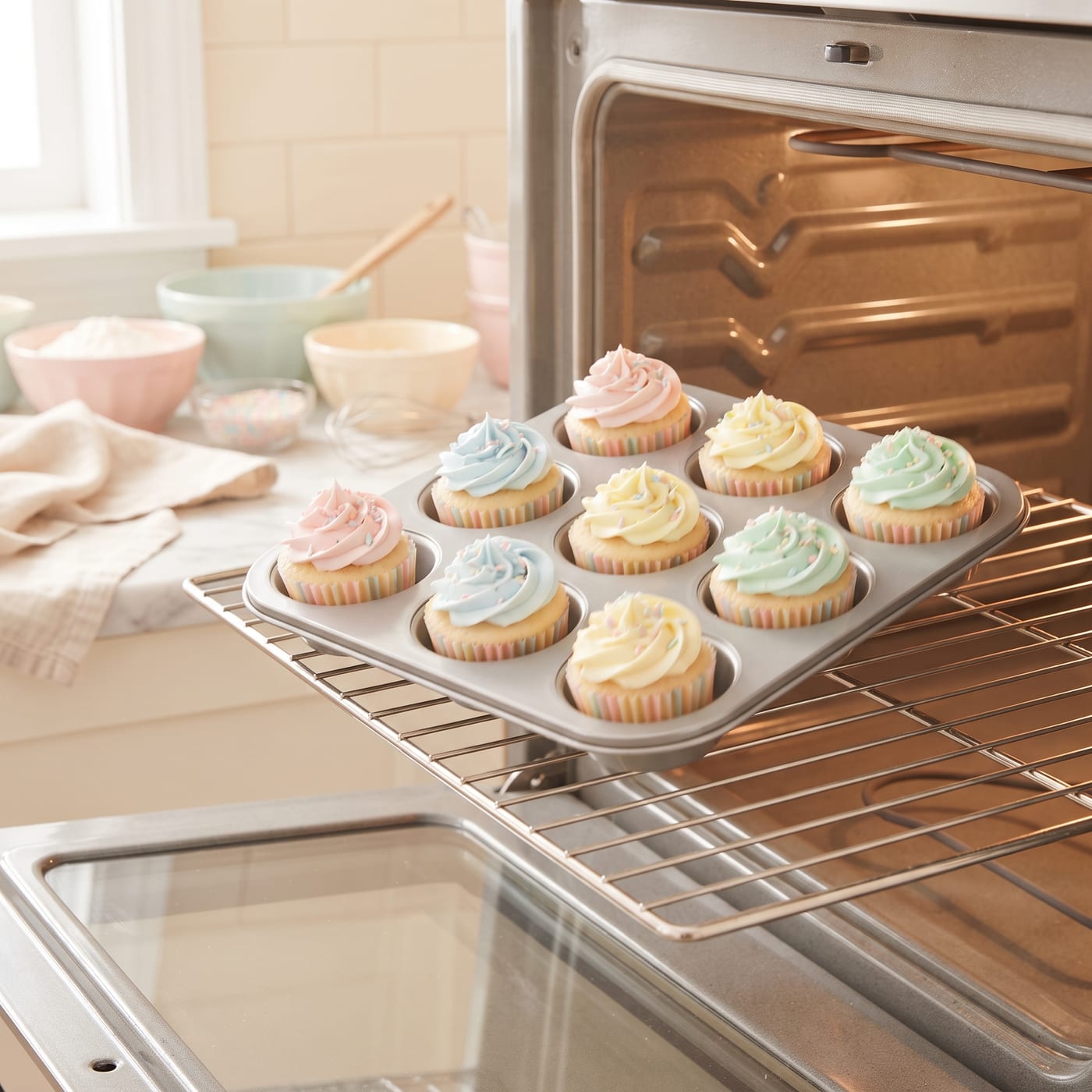
Rotate your trays once, at the halfway point of the bake time, and do both moves together. Swap the top tray to the bottom rack, and turn each tray 180 degrees so the back faces forward.
For an 18 minute bake, that means opening the door once around minute 9, working fast so the oven does not lose too much heat. Opening the door repeatedly drops oven temperature by 25 to 50 degrees each time, and that is what causes sunken centers in delicate batters.
- 18 to 20 minute bake: rotate once at minute 9 or 10.
- 22 to 25 minute bake: rotate once at minute 11 or 12.
- Never rotate in the first 10 minutes, rising batter needs stable heat.
Pan Choice and Batter Prep for Large Batches
Your pan material changes bake time as much as rack position does, so match pans across all trays if you can. Light aluminum pans reflect heat and bake evenly, while dark nonstick pans absorb heat and brown edges faster than the centers cook.
Mixing all your batter at once also matters more than people expect. Batter that sits 20 minutes while you portion tray after tray loses some of its rise from baking powder, so I scoop the first two trays immediately and only let a small bowl wait for the next round.
Troubleshooting Uneven Batch Bakes
Uneven bakes almost always trace back to airflow, oven hot spots, or skipped rotation, not bad batter. If one tray consistently bakes darker, mark that rack position and always put your thinner batter batch there instead.
A quick oven thermometer check solves more mystery problems than any recipe fix. Many home ovens run 15 to 25 degrees off their dial reading, and that gap gets worse the more trays you load in at once.
- Pale, underbaked centers: oven ran cool, or door opened too often.
- Dark edges, raw middle: tray too close to a wall or heating element.
- One tray always slower: swap rack positions next time you bake.
FAQ
Can I bake 24 cupcakes in one oven at the same time?
Yes, if you use two trays of 12 on separate racks with 2 inches of clearance around each. Rotate them once at the halfway point for even color and rise.
Do I need to adjust the temperature when baking multiple trays?
No, keep the same recipe temperature, but plan to add 2 to 4 extra minutes total bake time. More trays mean more mass to heat, so cupcakes bake slightly slower than a single tray.
Why do my back row cupcakes bake faster than the front row?
Most home ovens have a hotter zone near the back wall where heating elements sit closer. Rotating trays 180 degrees at the halfway mark fixes this without changing rack height.
Is it better to use a convection setting for large batches?
Yes, convection helps a lot for three or more trays because the fan pushes air evenly around every rack. Without convection, stick to two trays for the most even results.
How much batter should I mix at once for 48 cupcakes?
Mix your full batch in one bowl if your recipe scales cleanly, then portion trays in stages. Batter with baking powder loses some lift after sitting 20 minutes, so bake portioned batter quickly.